




We all dream about that “high school love story.” You know the type. Squealing to your best friend, talking on the phone past midnight, kissing in the rain, suddenly every song you hear is about them, that kind of love.
Surely in all these daydreams no one ever pictured having to go to every dance with a different person. No one fantasized about having panic attacks when your mom almost finds a boy’s sweatshirt in your laundry. No one wanted to feel guilty for simply feeling attracted to someone. Nevertheless, this is the reality of many teenagers in Provo, Utah.
Provo is objectively obsessed with marriage. The median age for first marriage in Utah is 25.2 for women and 26.8 for men, the youngest in the nation.* Furthermore, 36% of BYU students are married by the end of their undergraduate education** as opposed to the 7% average across the US.***
These stark contrasts can be attributed to The Church of Jesus Christ of Latter-Day Saints, which 90% of Provo are members of,**** a religion that prioritizes marriage and beginning a family as one of their highest responsibilities and blessings.
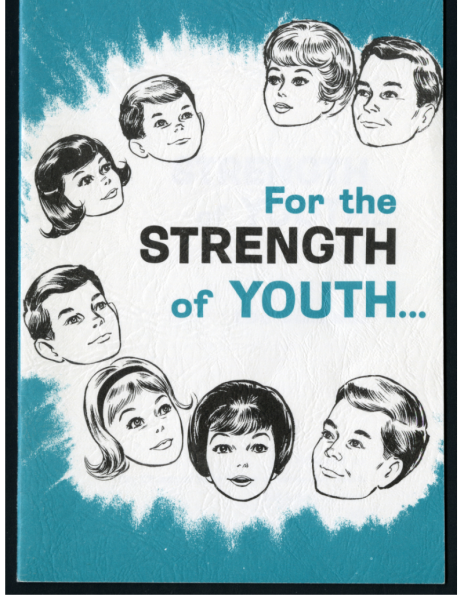
The Church of Jesus Christ of Latter-Day Saints has a written code of conduct for the youth of the church, that is For the Strength of Youth. The first edition of For the Strength of Youth was published in 1965 and advised on topics such as dating, haircuts, and how pants are not an acceptable thing for women to wear to the library. It was in this publication that the infamous lines, “there should be no dating before the age of sixteen” and “variety in dates is desirable” were written, setting off the culture of youth dating in the LDS church and Provo by extension.

The For the Strength of Youth pamphlet has had 10 different editions from its inception to the most recent in 2022. Most current teenagers had parents who grew up with the 1990 or 2001 edition, the first editions to have the section “sexual purity” and the first containing overt mentions of homosexuality. The rules surrounding dating were made more clear and strict than before, specifically mentioning that teenagers should not be “pairing off exclusively.”
Though the most recent update has softened the rules all around, emphasizing the need for personal revelation and agency, the contents of the old editions have continued to influence the culture of Provo, as the youth these pamphlets once spoke to are now adults raising high school aged children.
This article is by no means a diss on the LDS church or a judgement on their policies or standards. An analysis of the culture in Provo would simply be incomplete if we did not acknowledge a religion that is a dominant part of the culture.
Ask any Provo teenager what their dating rules are and you’ll likely hear something along the lines of “I can’t go to dances until I’m 16,” “Only group dates until I graduate high school,” or “I can’t go to more than one dance with the same person.” This explanation, however, will more often than not be followed up with a tale of switching dates with their friend at a dance, a secret messaging app, or even an entire secret partner.
The teenage years are a strange part of life, as we’re dealing with grown up feelings in an underdeveloped brain. A fundamental part of the teenage years is developing romantic feelings for others. The forbidding of romance by parents does nothing to stop something ingrained in our very makeup. All it does is eliminate a path of communication between parent and child.
I could tell you countless stories of friends who were in a relationship hidden from their parents, treated poorly or put in a dangerous situation by their partner, and had no one to tell.
It begs the question, why are parents eliminating safe ways for their children to explore crushes, romance, and dating? We all know teenagers are going to find a way to pursue romantic relationships whether their parents support it or not. So why eliminate things like dates, dances, or fun group hang outs?
When parents remove the option for safe, fun, public dates in restaurants, parks, movie theaters, and high school gyms, many teenagers find that the only way they’re able to pursue their feelings is to sneak around, pursuing a more physical and less social relationship than they may have been originally inclined to.
This heightened pressure also leads high schoolers to view their relationships as more serious than they are. The combination of anxious parents and social/religious pressure makes every relationship feel like it has to be THE relationship, even if you’re only 16. Putting that kind of pressure on a decision made at 16 is absurd when it’s well known that our brains don’t develop fully until we’re at least 25.***** The amount of people I’ve heard say they’re only dating people “I can see myself marrying” is outrageous considering we are children.
You shouldn’t go into a relationship thinking about how it will end, but you shouldn’t go into it thinking it will last forever either. Forcing some sort of commitment is going way too far at this age, even if you feel like you both “want it” or you’re both “ready for it.” You’re not. That pressure will tear apart your relationship before it’s even got a chance to really start.
Dating in high school should be about fun, connection, and experience. It should be about finding someone you genuinely enjoy spending time with and spending time with them. It should be about learning how to compromise and communicate, and how to not be a giant red flag when it actually gets serious in the future. Live in the moment, have fun, and remember that very few things in high school are quite as serious as they may seem.
*https://gardner.utah.edu/news/utahs-marriage-trends-young-married-and-changing/
**https://universe.byu.edu/2016/09/01/byu-marriage-statistics-reflect-us-trends-attitudes/
****https://www.chicagotribune.com/2019/02/14/why-a-trip-to-provo-utah-is-in-order/






Emily • Dec 2, 2025 at 4:31 PM
sloannnn you did such a good job writing this!
Elizabeth • Dec 2, 2025 at 11:56 AM
I fear this article is too real