


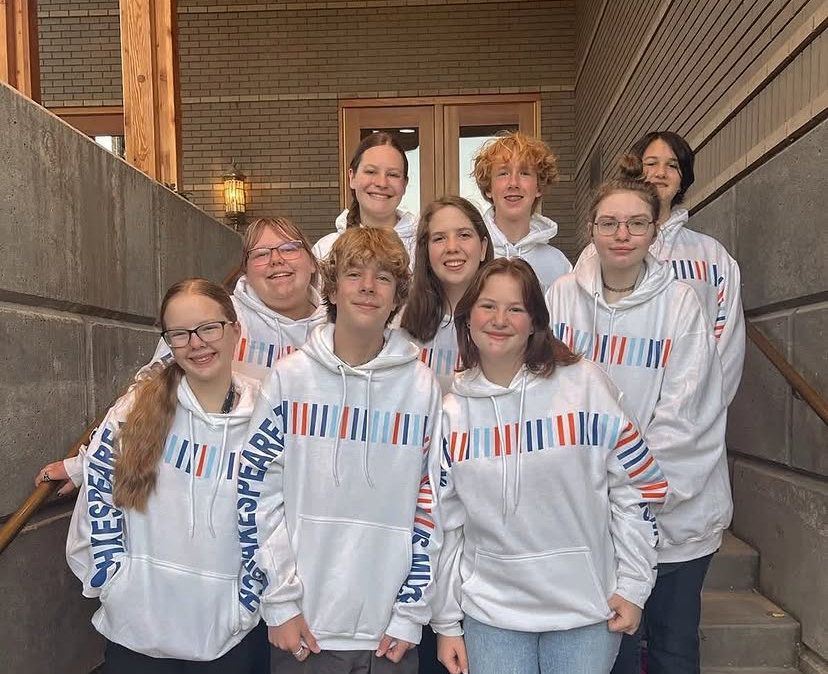
“It’s all I do with my life,” Tali West, a sophomore at Timpview, began our interview about the school’s technical theater program—the program she was partially responsible for running in her second year. Technical theater is a class of 30 students who are behind the scenes of every concert for dance, orchestra, band, and choir; every musical and play; every assembly; and anything else taking place at Timpview that uses the auditorium, sound system, or lights.
“If you’ve ever been to a production, or anything that in any sort of venue, or even anything on TV, anything that isn’t the actors is tech,” (Tali West). More specifically, Timpview’s tech program is split into stage management, set, costuming, hair, makeup, props, scenic design/painting, dramaturgy, lights, and sound—with Mrs. Napierski directing, and Skyler Millet as the technical director.
Mrs. Napierski, who teaches the technical theater class (as well as teaching Timpview’s three drama classes, the musical theater class, and directing the extracurricular school musical) said, “It’s very stressful. There’s so much that could go wrong that’s out of the control of the director or the student because you’re dealing with technology, and a live space, and high school students. So you can do as much prep as you want (…) but it doesn’t mean it’s going to go the same way during a show. It’s a little nerve-wracking.”
Colin Myrick, a freshman at Timpview, and another tech student—or techie/tech, as they’re more commonly called—said tech is “definitely a lot of hard work. Everything is very depending on time and resources. (…) And I think describing that to other people is like saying, (…) it’s a lot of hard work. You need to get creative. And it’s super fun. But you need to be able to do it. You need to actually take initiative and do it.”
When you start in the tech class, you take a tour through the auditorium, seeing how to turn on the sound and light boards, how to use saws for set-building, and how to use the fly-system— which controls everything that can come down from the ceiling (lights, curtains, set pieces, etc.). You’re then introduced to the show that the theater department is doing at that moment, which is most of what you’ll be working on. For each show, crews—groups of techs assigned to work on each element of the show—are determined based on google forms listing their preferences. It’s not a very structured class due to the many elements; this means the class is almost entirely student-led. If you’ve ever seen a show at Timpview, the set, lighting, costumes, hair, and makeup were also chosen and/or designed by a student.
In the two weeks before the Winter play—Almost, Maine—Colin was spending five to six hours a day on the show, and Tali was spending even longer. But no techie or actor can be at the school working on a show without Mrs. Napierski there to oversee everything.
This is Mrs. Napierski’s second year teaching at Timpview, and the changes she’s made to the theater department in those two years are substantial. She added a musical theater class, led Timpview to winning second place at State, and has petitioned for her techs to get paid for any outside projects done outside of Timpview’s department. Napierski has tried to build her department on unconditional support and community, and that extends to technical theater. She wants her techs to feel appreciated “more than anything. (…) [Our] tech department does not exist if kids don’t feel like their voices and their time and expectations are being reached. So that’s probably like my top priority is just to feel like they enjoy being there and they want to be there.” Techs often go underappreciated, as their work is behind the spotlight, not in it, but as Napierski said, “truthfully we cannot do without our techs.” Talking to techs, they’ve noticed Napierski’s efforts to put techs in the spotlight, to make them feel appreciated, and to push for equality between techies and actors. While they have expressed some separation between techs and actors, that’s to be expected, and there isn’t really any hostility or judgment.
“There’s just, like, a lot of, definitely a lot of bonding [between techs] because you’re building a show. And there’s just a lot of, like, teamwork that needs to happen. Like, it is a TEAM. (…) And I feel like everyone really gets to know each other quickly. (…) I have made so, so many connections. and I think it’s a great community overall. I feel like the theater community in general, I feel like people always say it’s super welcoming, and it is” (Colin Myrick).
Tali told me that a lot of techs end up doing tech by accident—that’s how she ended up as the stage manager of Timpview’s winter play (Almost, Maine) and the assistant stage manager of the two musicals (The Little Mermaid, The Addams Family) in her sophomore year. A lot of techs join the class for one reason or another, not knowing a ton about it, and discover a passion for it. Tali did tech in middle school, but she hasn’t been leaps and bounds ahead in opportunities. Tali attributes her success in tech to a few things: she’s taken more opportunities for experience, she had phenomenal teachers, she sees herself doing this in the future, and she’s always pushing to learn and do more. Everyone in the theater department knows Tali, and everyone loves her; she really is outstanding at what she does. Tali puts her absolute all into tech, and it shows.
Colin’s story is not dissimilar to Tali’s; he started in middle school, has experience outside of the classroom, and has taken on a large amount of responsibility very quickly and competently. As a freshman he was head of dramaturgy, head of props, and assistant stage manager multiple times. He wouldn’t recommend other freshmen try to wear that many hats at once, and has been understandably stressed out by it.
I was shocked when I learned that much of technical theater was being managed by underclassmen; in the large majority of activities responsibility is assigned based largely on seniority. Last year, senior techies were seen as the faces of the class, but this year it skews much younger. Why? Why were people leaving? “A few people have left tech because it is so mentally taxing. It can be a lot. It is hard. (…) You put in a lot of after-school hours and you put in a lot of at-home hours figuring stuff out. And sometimes that can take away from being able to do academics, like, being able to get good grades and being able to pass your AP classes and stuff. (…) I mean, a lot of people who have dropped tech are seniors and they’ve been doing this for a long time, so they’re kind of there’s that burnout. Like, there’s people talking about how seniors have academic burnout, there’s also tech burnout” (Tali West). Napierski has tried to prevent this “tech burnout,” but the truth is, there’s a lot of work that goes into tech, and sometimes it’s simply not possible to cut down one person’s load without overwhelming another’s.
Another problem the department faces is the space. It’s difficult to find a high school techie without complaints about their auditorium, and Timpview techies are no different. The auditorium is old, and thus faces challenges with lights and sound. Tech also doesn’t have access to a full metal shop, which limits set design and building. But despite the frequent complaints, when I asked about the auditorium, the majority of feelings were positive. The most notable thing is the size of the auditorium. The auditorium itself is quite large, the stage is massive, and there’s a wood shop, orchestra pit, costume and prop closet, 4 reasonably sized dressing rooms, and importantly to the techs, a full fly rail system. A full fly is what allows things to come down from the ceiling, something the new auditorium will not have. This new auditorium will also be smaller, placing a limit on every one of the many clubs and classes who use the space.
But the future of Timpview’s technical theater is bright. There are so many bright and talented kids who are dedicated to improving the program and Mrs. Napierski is dedicated to giving these kids more opportunities to succeed. Technical theater is essential for not only theater, but for all of the arts. The people behind the scenes run the show, and for too long they’ve gone unappreciated for all of the countless hours of work put into running the arts.