



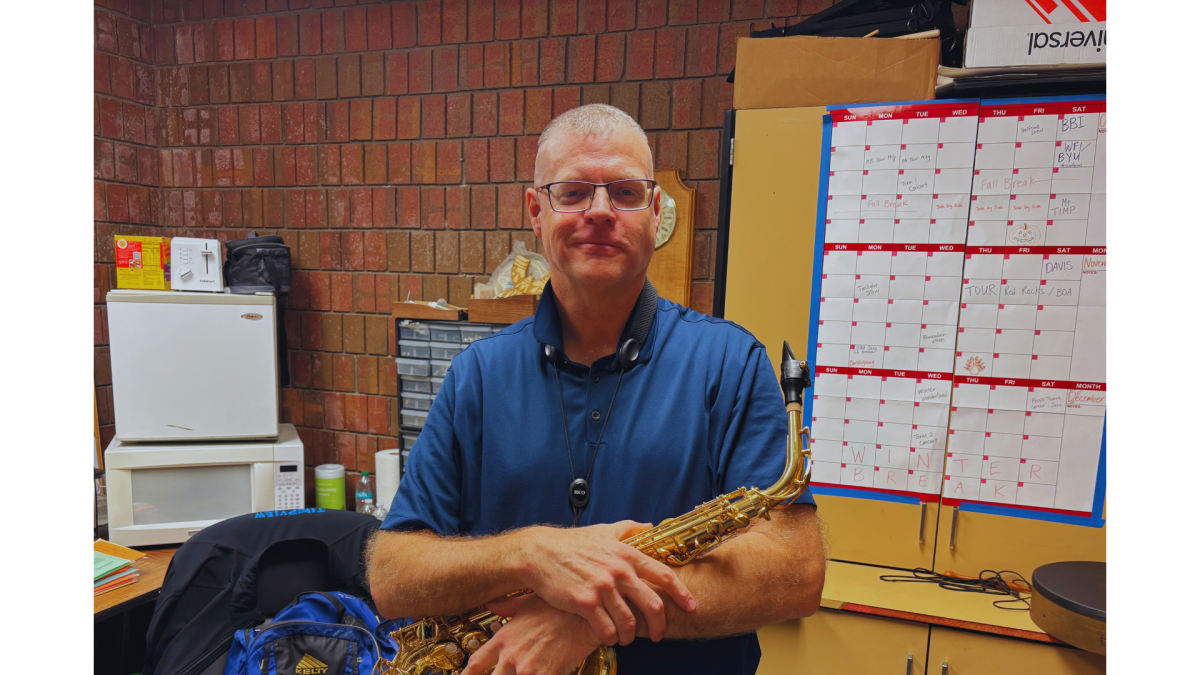
Just recently, Mr. Johnny Bolton received the Golden Apple Award. Bolton changed many lives and helped so many kids feel loved and accepted, myself included. He is one of the smartest and most charismatic people I have ever met. He pushes students to do their best and treats everyone like the equals they are. This is my conversation with him.
———
D.C.: How long have you taught here at Timpview?
J.B.: I started in 2019. I started on July 4th… July 3rd, July 4th, 2019. So, pushing seven years.
D.C.: And how have you enjoyed it so far?
J.B.: You know, I’ve really grown to love it. When I first got here it was a complete firehose; I was overwhelmed. I taught in rural schools up until the spring of 2017. And I was in charge of small schools, full programs—for the first eight years I was teaching K-12. And then the next thirteen-ish years I was teaching 6-12, so just band. The K-12 years were everything: band, choir, general music, coached football… I worked for a logger in the summertime. So, a lot of different things.
And then we moved to Utah in 2017. My daughters grew up, got married, moved here, and started having kids. So we pulled up roots in Colorado and moved over here. I was pretty tired… just a lot of frustrations in life as we were leaving Colorado, and that completely disrupted my whole life vision for what I was going to do. I spent a couple years kind of floating in the dark abyss—applying for jobs, doing some interviews, and nothing really happened.
And then in the summer of July, the Timpview gig became open. I applied for the job and got a call to come in and visit with Momi, and they hired me. A lot of self-doubt when I first started. I had major impostor syndrome because I didn’t know how to do everything with a large program. The sheer quantity of things to do was incredibly overwhelming.
And then the students—bless their hearts—had to go through early Bolton. It was a big disruption to have them lose their long-standing director, and their successful program; just all of the things that they had to deal with in that transition. And so, the first three or four years: pretty tough. The last three years have been really good. I’ve learned, I’ve got an office assistant now that’s working with me, which has made a world of difference.
But I really love working here. I’ve discovered, working in small schools and big schools, that students are… I mean, the same people, though—the same. It doesn’t matter if it’s small-town Colorado or Orem/Provo… it doesn’t matter where you are. Being able to create a relationship and work to develop a satisfyingly successful program… The details are a bit different, but the global—it’s the same.
You know, I think I’ve learned since I started teaching in ’94, I have discovered how to be a better human being working with students. A lot of friction at the beginning; a lot of rough edges chunked off this old guy as I worked through. And so, you know, when the award came in earlier this week—I still kind of live in that mindset of “I’m not a very good human being,” “I’m not a very nice teacher,” “I’m kind of an impostor.” And all those thoughts flooded. And then it’s just like, if people think that you’re loving and kind and interested, then you just darn well better keep working that direction. Because that’s what’s expected of you, and that’s a good thing to be.
So, get rid of your biases and get rid of your meanness and get rid of your insulting behavior and step up to the plate. So, I don’t know, teaching has been a life-changing career path for me. In order to be a better teacher for students, I’ve had to focus more on becoming a better person so that I would be of use to my students. Which is nothing I would have even imagined as a 20-year-old. That wasn’t on the radar, wasn’t on the horizon, wasn’t in the books. But now, if I were to say you’re going to go into teaching: the students have to be first, but right close second to that has to be a sense of excellence. Because that’s what you have to offer the students.
Offering them excellence and bulldozing through anything that happens to get that excellence destroys people. And just loving people and not worrying about excellence also destroys people. So it feels to me like it’s a razor’s edge; you’ve got to walk a fine line—personal development, a lot of planning, a lot of foresight. Like, what do I do now that helps the outcomes for these students be better?
So, I don’t know. It’s been a development. I feel like I’m not quite an infant in the industry anymore, but every day I wake up and go to work. The work is familiar, but I still feel like I’m brand new at this and I kind of look for the day when I get it figured out. When everything falls into place the way it should and maybe it’s not quite as hard as it is. Don’t think that day will ever come. But that’s why you know, I get up in the morning: “When am I going to become a good band director?” I don’t know. Just keep going, keep planning, keep trying, and it’ll eventually get there.
And that’s, I think, how I approach my students. You’re not maybe what you want to be now, but I’ve seen enough students develop that in four years you’ll become what you think you want to be—you’ll be closer. It takes some effort. You’ve got to sit down in the seat, you’ve got to do the work. And where you end up and where somebody else ends up, it’s so not important. Maybe use other people as a guidepost, but man, don’t use them as a rubber stamp because you’re not going to fit. You’re not going to be that person. You know, I can’t be Mr. Harold. He’s really a great musician, he’s really a great band director, he knows stuff that I just don’t think I’ll ever know. So I can’t compare myself to him or, you know, anybody else that I would look really up to. That’s not the point. The point is: what’s next for you? How can you be better organized? How can you pick better tunes? How can you listen better to students when they have good ideas? How can you implement those ideas? If they’ve got bad ideas or bad things that are happening that are inhibiting them, how can you identify it and diplomatically help them change course a little bit so they can be more successful? I think that’s my perspective at this point, boiled down.
D.C.: Has Timpview been your most enjoyable school to work at, or do you not know yet?
J.B.: Hard to say, because you know when you look back in the past, you tend to—at least I do—you tend to forget how hard it was and you just look at the glory points.
D.C.: Definitely rose-colored glasses.
J.B.: Yeah, yeah. So what it was, was pretty good. But I don’t really remember what it was like to be the guy who drove the bus, the guy who rehearsed the music, the guy who ordered the food, the guy who did all the… I don’t remember how much of a frustration that was. I just remember having some really fun performances. I remember some great parents and some great community members.
So right now, while I’m in the fight, it’s a different experience. I think it’s a bigger experience. It’s huge. I think when I retire I’ll be able to look back and just be super grateful that I was able to “man up” and put the Timpview coat on and wear that weight and try to grow from it. So, I don’t know if I’d compare better or worse. It’s different. It’s different than teaching kindergartners, it’s different than coaching football, it’s different than being completely in charge of the whole entire instrumental program.
Would I give up the experiences I’m having now to go back to those? Some days… some days! [Laughs] Some days I’m just like, “Oh man, I could be so much more successful if I had less work to do.” Is that true? Probably not. I mean, this is the same guy going to do the work, so he’s probably going to take the same problems with him. But I don’t know… I am glad to be here. I’m very glad to be here. Glad to work with the people. We’ve got a performing arts department that’s just stellar. I’ve got great students. You’ve got some knucklehead students; they’re flavor.
D.C.: Knuckleheads like me? [Laughs]
J.B.: [Laughs] You’re not a knucklehead… often.
D.C.: [Laughs] If there was one thing that you could say to a student that they could just hold with them for the rest of their life—be it music, be it to become a better person—what would you send them off with?
J.B.: Keep your feet moving. Don’t stagnate, and don’t look for a reason that somebody else victimized you. Just keep moving. Own everything. Own everything that’s happening to you. When it’s out of your control, then you still own the movement you’re making. You know, sometimes I feel like we spend some time feeling sorry for ourselves and making it other people’s fault—that’s when our feet stop moving. Keep your feet moving. Make you the person who’s making this dynamic happen. Don’t let it be someone else’s fault for stopping you. Which is really hard. But that, I think, would be the essence of what I try to operate on.
D.C.: All right Bolton, thanks so much.
J.B.: Thank you, man. Appreciate you.














Benny • Mar 23, 2026 at 4:42 PM
Thank you so much for posting this interview. I watched my dad grow as a person, teacher, and parent through all of the phases he talked about here, he was my music teacher from kindergarten through high school (year of 2009) and music has always been the language we really connect the most over. Even though I’m his own flesh and blood he never treated me much different than his own students except that he had a higher of expectations for me. He really loves his students as if they were his own kids, even calls them “my kids.” Reading this brought back a huge wave of memories of band trips, performances, mishaps, really good food (there’s ALWAYS food analogies), and 6-hour bus rides where we just talked and, once, I had to transcribe all of my jazz band music from the score because I forgot my folder. Mr. B has a way of being present with people and making them feel important, and it’s not a surprise to me that the people in his community have noticed that. Way to go, dad! Love ya.